
William Blake
William Blake
28 November 1757 – 12 August 1827
English poet, painter, and printmaker. Largely unrecognised during his life, Blake has become a seminal figure in the history of the poetry and visual art of the Romantic Age.
Felpham
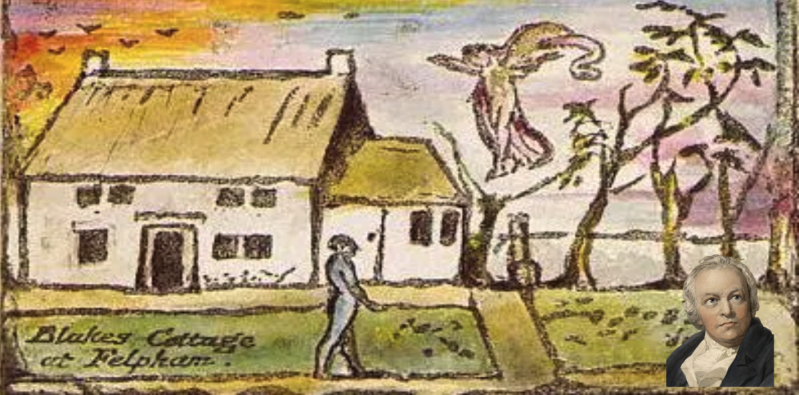
William Blake lived in Felpham for three years, arriving in September 1800 and departing in September 1803.
A memorial plaque outside of The Fox Inn in Felpham describing Blake's arrest

In 1800 Blake moved to a a cottage at Felpham, in Sussex (now West Sussex), to take up a job illustrating the works of William Hayley, a minor poet. It was in this cottage that Blake began Milton (the title page is dated 1804, but Blake continued to work on it until 1808). The preface to this work includes a poem beginning "And did those feet in ancient time", which became the words for the anthem "Jerusalem". Over time, Blake began to resent his new patron, believing that Hayley was uninterested in true artistry, and preoccupied with "the meer drudgery of business" (E724). Blake's disenchantment with Hayley has been speculated to have influenced Milton: a Poem, in which Blake wrote that "Corporeal Friends are Spiritual Enemies". (4:26, E98)
'Skofeld' wearing "mind forged manacles" in Jerusalem: The Emanation of the Giant Albion, Plate 51

Blake's trouble with authority came to a head in August 1803, when he was involved in a physical altercation with a soldier, John Schofield.[56] Blake was charged not only with assault, but with uttering seditious and treasonable expressions against the King. Schofield claimed that Blake had exclaimed "Damn the king. The soldiers are all slaves."[57] Blake was cleared in the Chichester assizes of the charges. According to a report in the Sussex county paper, "[T]he invented character of [the evidence] was ... so obvious that an acquittal resulted".[58]Schofield was later depicted wearing "mind forged manacles" in an illustration to Jerusalem The Emanation of the Giant Albion.[59]
Blake's Counsel
Here's a glimpse into the wisdom he might impart if he was with us today...:
On Vision and Purpose:
-
"See a World in a Grain of Sand, And a Heaven in a Wild Flower, Hold Infinity in the palm of your hand, And Eternity in an hour." He'd urge you to never lose sight of the profound potential within each individual you aim to serve. Your enterprise is not just about transactions; it's about unlocking that inherent worth.
-
"The Vision of Christ that thou dost see Is my Vision's Greatest Enemy." Be wary of rigid dogma or societal norms that limit your understanding of inclusivity. Embrace diverse perspectives and challenge conventional boundaries. Your vision should be expansive and ever-evolving.
-
"He who binds to himself a joy Does the winged life destroy; But he who kisses the joy as it flies Lives in eternity's sunrise." Don't cling too tightly to a fixed model. Be flexible, adapt to the unique needs of the individuals you serve, and find joy in the dynamic process of empowerment.
On Action and Implementation:
-
"Pity would be no more, If we did not make somebody Poor." Blake was deeply critical of systems that perpetuate inequality. He would implore you to examine the root causes of exclusion and actively work to dismantle them through your enterprise model. Ensure your practices empower and uplift, rather than inadvertently creating new dependencies.
-
"The strongest poison ever known Came from Caesar's laurel crown." Beware of the allure of power and prestige. True success lies not in hierarchical structures but in fostering a sense of shared ownership and mutual respect within your enterprise and the communities you serve.
-
"Labour well the minute particulars, attend to the little ones."Inclusivity isn't a broad stroke; it's found in the details.Pay meticulous attention to the individual needs, experiences, and voices of those you aim to include. Small acts of genuine care and consideration will have a profound impact.
On the Human Spirit:
-
"All deities reside in the human breast ." Recognise the inherent dignity and creativity within every person, regardless of their background or perceived limitations. Your enterprise should be a space where these inner "deities" can flourish.
-
"What is now proved was once only imagin'd. "Don't be afraid to dream boldly and imagine new possibilities for inclusion. The most transformative changes often begin with a seemingly impossible vision.
-
"The man who never alters his opinion is like standing water, and breeds reptiles of the mind." Stay open to learning, evolving, and challenging your own assumptions about inclusivity. Engage in continuous reflection and be willing to adapt your approach as you gain new understanding.
In essence, William Blake would likely encourage your inclusive social enterprise to be a beacon of empathy, a catalyst for genuine connection, and a testament to the boundless potential that resides within every human heart. He would urge you to see beyond surface differences, to challenge societal constraints, and to build a world where all can thrive in their unique and glorious individuality.
Beyond the Urizen
by Galdor se Scop
From London’s smoke and dark despair,
I fled to breathe a sweeter air.
To Sussex fields, where Felpham lies,
Beneath the vast and watchful skies.
No ‘chartered street’ the eye did see,
But Eden’s wall, or so seemed me.
A cottage small, a garden bright,
Bathed in simple, southern light.
The sea did moan upon the sand,
Where England’s pastures gird the land.
And in that sound, a whisper deep,
Of souls that wake, and souls that sleep.
I walked the shore at evening’s gleam,
And saw a vision, or a dream.
Not Urizen’s cold iron law,
But forms of beauty that I saw.
The sun, a flaming cherub high,
Did light the spirit’s inner eye.
The moon, a pale and silver thought,
The mysteries the ages brought.
The nightingale from heaven sprung,
His joyful hymn for truth has sung.
The rose, upon its thorny stem,
A living, breathing, diadem.
But lo! A shadow, cold and vast,
From Satan’s forge, its shape has cast.
For even here where peace should dwell,
The serpent whispers from his cell.
The spectre of the age’s fear,
Did rise and strive to draw me near.
To bind the soul in chains of doubt,
And blot the sacred fires out.
O Felpham, hold your gentle sway,
And chase the swicol far away!
Let Imagination, strong and free,
Restore the lost eternity!
For heaven is here, and hell is too,
In all we think and all we do.
And every grain of golden sand,
Contains the secrets of the land.
Blake’s Bognor Vision
By Jill Palmer
Blake left his cottage for a walk,
His heart was heavy, footsteps slow,
His sharp mind blurred and clouded,
In melancholy, spirits low.
Lamenting creativity,
Crushed by the mills of education,
And workers spending lives untouched,
By their divine imagination.
Even children toiled, underfed,
Minds shackled so they can’t begin,
To cease their hunger’s constant cry
And reach the greater life within.
Then on his path he came upon,
A thistle he had met before,
One that he had argued with,
And found an aggravating bore.
‘William Blake,’ the thistle said,
‘From your countenance, I see you mope,
Look yonder there along the shore,
And what you see may bring you hope.’
And beyond the thistle’s prickly head,
White domes rose like clouds on high,
Topped with brightly shining spears,
Reaching into Bognor’s sky.
And beneath them lay a paradise,
Of sound and colour by the sea,
With fountains, feasts and carousels.
A place of such divinity,
Where England’s workers could relax,
And take a break from earthly state,
Unencumbered by their daily strife,
And leave Urizen at the gate.
There, music such as never heard,
Pulsating with hypnotic beat,
Would bring them close to ecstasy,
As it entered through their feet.
Children’s minds could come to life,
As the gnaw of hunger ceased,
They would laugh and play and swim,
All their tethered thoughts released.
Their eyes would feast on such delights,
And angels would enrich their soul,
Bringing to them love and joy,
In the form of ‘Paw Patrol’.
So, Blake wandered through the vision,
Of this England so desired,
His mind’s eye full of sights, smells, sounds,
Creative inspiration fired.
And he could see the nation’s mind,
Unchained in this promised land,
The prospect filled his heart with joy,
Until it faded into sand.
Now knowing what could come to pass,
At this place on Felpham’s shore,
Blake turned for home, his spirits raised,
His footsteps lighter than before.
Later, writing poetry, the
Strange word ‘Butlins’ filled his head,
But it didn’t fit the line so,
He used ‘Jerusalem’ instead.
SWEET FELPHAM
By Mary Halpin
And didst thou leave the dungeon dark
Bearing sand and sparks of fire;
And could thy bow of burning gold
Find that gate open to desire?
And didst thou find a place of joy
Among the birds and fields of grain;
And were sweet voices raised in song
As thou strolled through old Felpham’s lanes?
Oh if I could but sail through time
Thou a stout captain at the helm;
Or walk with thee to quaff an ale
Or find thee deep in poesy’s realm
I scour the shore by leaden waves
I search our streets in vain for thee;
Yet left behind is such a mind
As England ever hopes to see.